
TL;DR
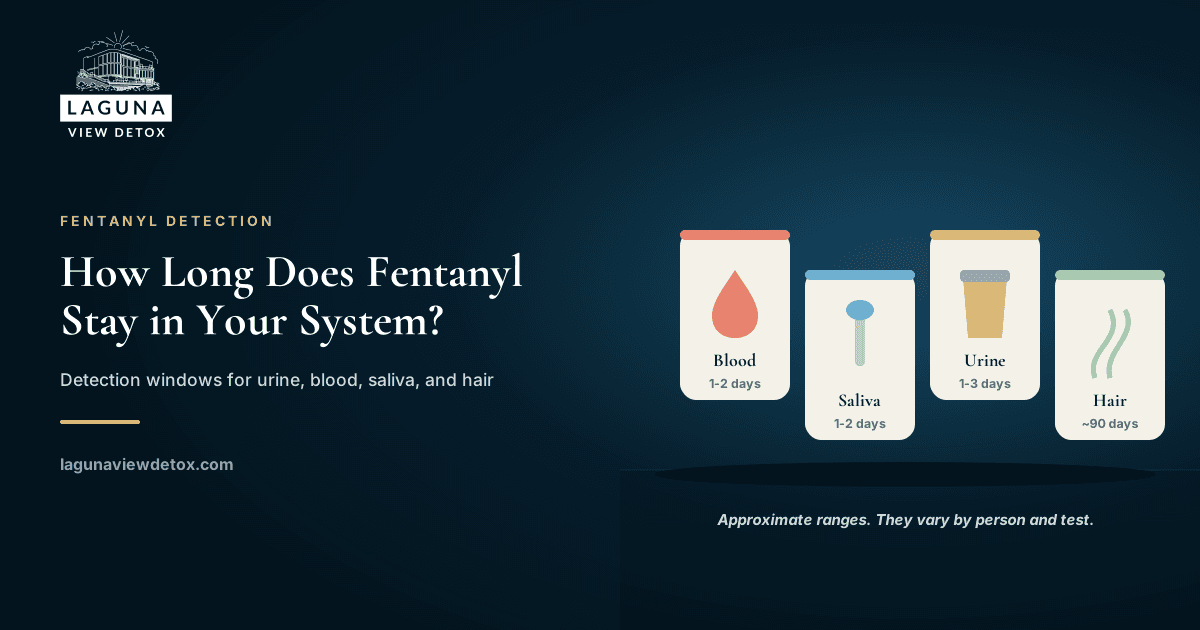
How long fentanyl stays in your system depends on the test. Blood and saliva catch it for hours to about a day or two, urine for roughly one to three days, and hair for up to about 90 days. These are general ranges, not guarantees.
Heavy or long-term use, body fat, liver function, the form of fentanyl, and the lab's cutoff level can all stretch or shorten those windows.
Detection time and withdrawal are different clocks. Fentanyl can leave a urine test while withdrawal is still hard.
Fentanyl is addictive and can cause a fatal overdose in small amounts.[1] If you are using it, medical detox is the safest place to stop.
Table of Contents
How long does fentanyl stay in your system? Detection windows by test type
Fentanyl half-life vs. detection time: what's the difference?
Introduction
You may be asking how long fentanyl stays in your system because something is coming up. A drug test at work, a doctor's visit, a court date, or a family member who found something and wants answers. Maybe you are asking because you want to stop and are afraid of what comes next.
We will give you the detection numbers plainly, and we will tell you where those numbers stop being reliable. Then we will cover the part most detection charts skip: how long fentanyl stays in your system is a different question from how long it takes your body to recover. If you want to understand the drug itself first, our article on what fentanyl is and its overdose symptoms covers that. This one is about timing.
What is fentanyl and how does the body process it?
Fentanyl is a synthetic opioid, made entirely in laboratories. It is approved as a prescription pain medicine, but most of the fentanyl driving the current overdose crisis is made illegally.[1] It is much more potent than morphine or heroin, and its effects can start more quickly.[2]
Your liver does most of the work of breaking fentanyl down. It turns the drug into metabolites, which are the leftover compounds your body then clears through urine. Fentanyl dissolves easily in fat, so some of it settles into fatty tissue and leaves slowly. That is one reason a single number never fits everyone.
Because fentanyl is so powerful, even a small amount can cause a fatal overdose. That can happen when someone takes it without knowing, because it was added to counterfeit pills or other illegal drugs.[2] Fentanyl test strips can reduce the risk of using drugs that contain it.[1]

How long does fentanyl stay in your system? Detection windows by test type
The honest answer is "it depends on what is being tested." The ranges below are commonly cited estimates from clinical and laboratory practice. The sources we reviewed for this article do not publish exact detection times, so treat these as approximate and ask a medical professional or the testing lab about a specific case.
Test type | Typical detection window | What it tells you |
|---|---|---|
Urine | About 1 to 3 days after last use; longer after heavy or prolonged use | Recent use. Most common test. |
Blood | Hours, up to about 1 to 2 days | Current or very recent presence |
Saliva | Roughly 1 to 2 days | Very recent use |
Hair | Up to about 90 days | Pattern of use over months |
Urine is where most people get tested, so how long fentanyl stays in your urine matters most in practice. For most people it falls in the one-to-three-day range, but a person who has used daily for months may test positive for longer.
Hair works differently. Drugs enter the hair as it grows, so a standard sample can reflect about three months of history. It will not show whether you used yesterday, because that hair has not grown out of the scalp yet.

Factors that affect how long fentanyl is detectable
Two people can take the same dose and have different results. These are the main reasons the timing varies:
How often and how long you used. Repeated use lets fentanyl build up in fatty tissue, which can extend detection after you stop.
Dose and potency. Illegal fentanyl has no quality control, so you often cannot know how much you took.
Body fat. Fentanyl is stored in fat, so more body fat can mean slower release.
Liver and kidney function. These organs break down and clear the drug. Reduced function slows that down.
Form of the drug. Patches, lozenges, injections, and pills release fentanyl at different speeds. A patch can keep releasing the drug for a while.
The test itself. Labs set cutoff levels. A sensitive test will find traces a basic one misses.
Other drugs. Some medications change how the liver processes fentanyl.
Age, hydration, and metabolism matter too, but less predictably. Drinking extra water or taking supplements will not reliably clear fentanyl, and the lab can flag attempts to cheat a test.

Fentanyl half-life vs. detection time: what's the difference?
Half-life is how long it takes your body to clear half of a drug from your bloodstream. Detection time is how long a test can still find the drug or its metabolites. They are not the same number, and people confuse them constantly.
Fentanyl's half-life after a single dose is short, a matter of hours. But the drug lingers in fat and keeps slipping back into the blood, and metabolites can stay in urine after the active drug is gone. So a test can come back positive long after you stopped feeling any effect.
The reverse is also true. You can stop testing positive and still feel the pull of the drug, because opioid dependence is a change in how the brain works, not just a chemical sitting in your body. NIDA notes that repeated use changes brain activity in ways that make people keep using even when they experience harmful effects.[1]

Fentanyl withdrawal timeline and why medical detox matters
Withdrawal is the second clock, and it does not match the first. Symptoms often begin within about a day of the last dose, though timing varies with how much and how long you used. They can include muscle aches, sweating, nausea, vomiting, diarrhea, anxiety, restlessness, and strong cravings. Fentanyl withdrawal is rarely life-threatening on its own, but it is miserable enough that many people return to use just to make it stop.
That is where the danger sits. After days without fentanyl, your tolerance drops. A dose you used to handle can now cause an overdose. Withdrawal-driven relapse is one of the most common ways people are hurt. If you ever need to know what to do in that moment, read how Narcan works.
Medical detox gives you around-the-clock monitoring, medication to ease symptoms, and a plan for what comes after. The American Society of Addiction Medicine develops evidence-based guidelines, called the ASAM Criteria, that clinicians use to match a person with the right level of care.[3] Our medical detox program follows that kind of person-centered approach. If you are wondering what the days look like, see a typical day in our program.
Federal rules have also eased access to medication treatment. The DEA states that a waiver is no longer required to treat patients with opioid use disorder.[4] That means more clinicians can offer it.

When to seek help: treatment options at Laguna View Detox
You do not need a failed drug test or an overdose to ask for help. Consider calling if any of these are true:
You have tried to stop and could not, or stopping made you too sick to continue.
You need more fentanyl to get the same effect, or you use it to avoid feeling sick.
You have overdosed before, or someone has had to revive you.
You use alone, or you cannot be sure what is in the pills you take.
Anxiety, depression, or trauma is part of the picture.
At Laguna View Detox, treatment starts with medical detox, then can continue into residential inpatient care. If mental health is part of what is driving use, our dual diagnosis care treats both together. Addiction therapies build the skills for staying stopped, and aftercare and alumni support keeps you connected once you leave.
If you are comparing programs, our guide on how to choose a detox center lists what to ask. You can also search for treatment options at FindTreatment.gov, which SAMHSA provides.[5]
Frequently Asked Questions
Q: How long does fentanyl stay in your urine?
A: Commonly about one to three days after the last use. After heavy or long-term use it can be detectable longer. The exact window depends on the dose, your body, and the lab's cutoff level.
Q: Can fentanyl be detected in a standard 5-panel or 10-panel drug test?
A: Often not. Standard panels typically screen for opiates like morphine and codeine, and fentanyl is synthetic, so it may not trigger them. Fentanyl usually requires a specific fentanyl test. If you need to know what a particular test covers, ask the lab or the person ordering it.
Q: How long does fentanyl stay in your hair, blood, and saliva?
A: Hair can show use for up to about 90 days. Blood generally shows fentanyl for hours up to a day or two, and saliva for roughly one to two days. These are approximate ranges, not guarantees.
Q: Does long-term or heavy fentanyl use make it stay in your body longer?
A: Yes, it can. Fentanyl is stored in body fat, and repeated use lets more of it build up. That can stretch how long fentanyl stays in your system and how long a urine test stays positive after you stop.
Q: How long does fentanyl withdrawal last, and is medical detox necessary?
A: Symptoms often start within about a day and are usually worst in the first several days, though cravings and low mood can last much longer. Medical detox is strongly recommended. It eases symptoms and lowers the risk of relapse and overdose when your tolerance has dropped.
Conclusion
Fentanyl usually shows up for hours in blood, a day or two in saliva, one to three days in urine, and up to about 90 days in hair, with real variation from person to person. But a clean test is not the same as being well. How to stop safely is the harder question, and you should not have to answer it alone.
If you or someone you love is using fentanyl, call Laguna View Detox. Our team can talk through your situation, explain what medical detox involves, and help you plan the next step. Call today, not after the test.
References
National Institute on Drug Abuse. Fentanyl. - https://nida.nih.gov/research-topics/fentanyl
National Institute on Drug Abuse. Fentanyl DrugFacts. - https://nida.nih.gov/publications/drugfacts/fentanyl
American Society of Addiction Medicine. ASAM - American Society of Addiction Medicine. - https://www.asam.org
U.S. Drug Enforcement Administration, Diversion Control Division. DEA Diversion Control Division | Home. - https://www.deadiversion.usdoj.gov
Substance Abuse and Mental Health Services Administration. Substance Use Disorder Treatment. - https://www.samhsa.gov/substance-use/treatment