

TL;DR
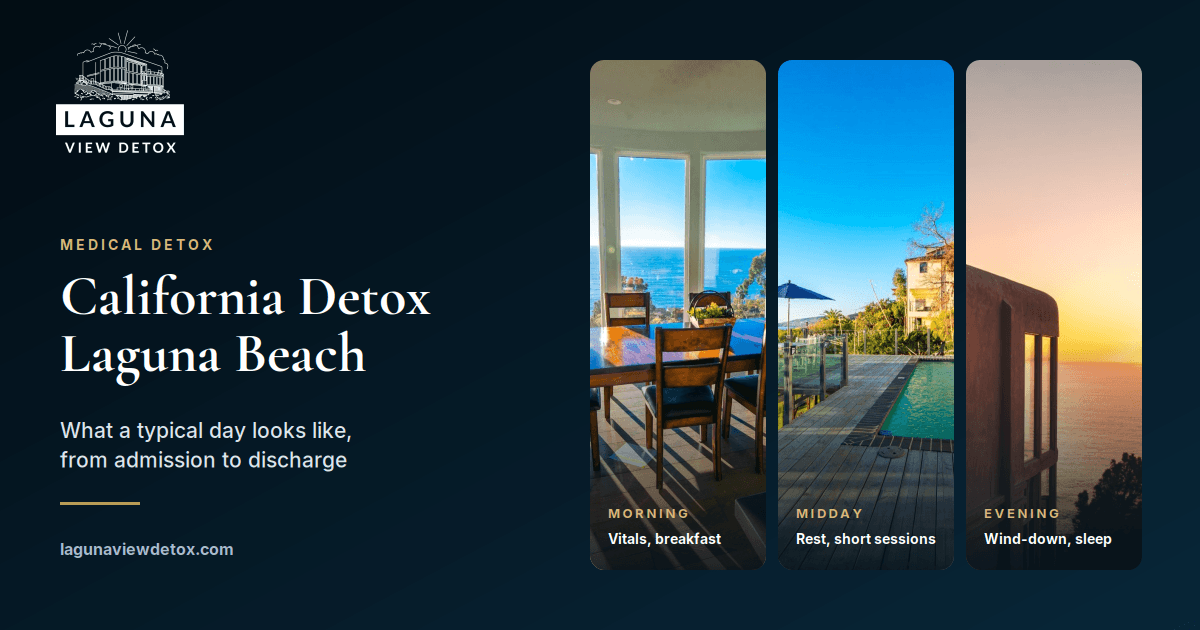
A california detox laguna beach stay follows a steady daily rhythm: vitals and medication in the morning, therapy and education at midday, monitoring and sleep support at night.
Day one is mostly intake, a medical assessment, and getting you comfortable. You are not expected to do much but rest and answer questions.
The days change as withdrawal eases. Less of the schedule is medical, and more of it is planning for what comes next.
Detox treats withdrawal. It is not the whole treatment, so discharge day is about a specific next step.
Table of Contents
Evening wind-down: monitoring, family contact, and sleep support
Discharge day: aftercare planning and next steps in treatment
Introduction
Most people who call about detox are not afraid of the schedule. They are afraid of the unknown: what the first night will feel like, who will be in the room, whether they will be alone. This article walks through an ordinary day at a california detox laguna beach program, so the unknown gets smaller.
The details below describe how medical detox generally works and how we approach it at Laguna View Detox. Your own days will be shaped by what you used, how much, and how your body responds. If you need to talk to someone right now, SAMHSA's National Helpline is available through the resources listed at samhsa.gov.[1]

Why medical detox matters: what to expect before you arrive
Withdrawal from alcohol and some other substances can be dangerous, not just uncomfortable. Medical supervision means someone can catch problems early and treat symptoms before they get worse. If you are unsure whether your situation needs it, our piece on warning signs that withdrawal needs medical supervision covers that question directly.
Before you arrive, a few practical things help:
Bring a list of every medication you take, with doses, and the name of your prescriber.
Be honest on the phone about what you use and when you last used. Nobody is grading you. Your answer decides how closely you are watched.
Pack comfortable clothes, basic toiletries, and a few photos or a book. Leave valuables at home.
The American Society of Addiction Medicine, which has set clinical guidelines for addiction care since 1954, publishes The ASAM Criteria, a framework used to match each person's needs to a level of care.[2] A good california detox laguna beach admission is built around that matching.

Admission day: intake, assessment, and getting settled
Day one is slower than people expect. You check in, hand over your belongings for a safety review, and meet the nursing staff. Then comes the assessment, which usually takes a good part of the first few hours.
The assessment covers what you use, how often, your medical history, any mental health conditions, and your current vital signs. If a mental health condition is part of the picture, that shapes the plan too, and our dual diagnosis program exists for that overlap. The result is a withdrawal plan written for you, not a standard one.
After that, you settle in. Eat something, drink water, sleep if you can. A nurse checks on you often, and you can ask for help at any point.

Morning routine: vitals, medication support, and nutrition
Mornings start with a check of your blood pressure, heart rate, temperature, and how you slept. Staff also ask how you feel, using plain questions: Are you shaky? Nauseous? Is your mind racing?
Medication, when it is needed, is given at this point and adjusted through the day. Different substances call for different approaches. NIDA notes that medications for opioid use disorder are safe, effective, and save lives,[3] and the same careful, symptom-by-symptom thinking applies to alcohol withdrawal. You can read more about how we run this in our medical detox program.
Breakfast matters more than it sounds. Withdrawal often leaves people dehydrated and short on nutrients, so staff encourage fluids and small, regular meals even when your appetite is gone.

Midday care: therapy, education, and rest
What you do at midday depends on how you feel. In the first days, rest comes first. As your body steadies, short sessions are added.
Those sessions are brief and low pressure. They might include:
A one-on-one conversation with a counselor about what brought you here.
A short education group on how withdrawal works and what to expect from your body.
Quiet time, a walk, or fresh air when your care team clears it.
Detox is not where deep therapy happens, because your body is still catching up. It is where you start. The longer work is described on our addiction therapies page. The setting helps too, and we cover that in how an oceanfront setting supports withdrawal.

Evening wind-down: monitoring, family contact, and sleep support
Evenings are when many people feel worst. Anxiety rises, cravings can spike, and sleep is hard. Staff keep a closer eye on you at night, and overnight checks continue while you rest.
Family contact usually happens in the evening, within the facility's guidelines. Phone policies in detox are often limited at first so you can focus on getting well, and we will tell you what applies to you at admission. Families who want to understand the process can ask staff for updates, with your consent.
Sleep support is practical: a dark, quiet room, a consistent bedtime, and medication for sleep or anxiety when it is clinically appropriate. NIAAA, the National Institute on Alcohol Abuse and Alcoholism, offers an Alcohol Treatment Navigator and plain-language material on alcohol use disorder that families often find useful while waiting.[4]

How days change as withdrawal symptoms ease
No two stays run the same length. The table below shows the general pattern of how a day shifts, not a promise about your own timeline.
Stage | What the day centers on | Typical feel |
|---|---|---|
First days | Frequent vitals, medication adjustments, rest, fluids | Physically hard, mostly sleeping and recovering |
Middle days | Fewer medical checks, short counseling and education sessions | Clearer thinking, more appetite |
Final days | Aftercare planning, family calls, treatment decisions | Steadier, more focused on what is next |
As symptoms ease, the medical part of the day shrinks and the planning part grows. That shift is a good sign, and your care team will tell you when it is happening.
Discharge day: aftercare planning and next steps in treatment
Discharge should never be a door that opens onto nothing. Before you leave, your team confirms where you are going next and how you will get there. For many people, that is residential inpatient treatment, where the deeper work of recovery begins.
Others step down to outpatient care, a sober living arrangement, or ongoing support through our aftercare and alumni program. You leave with appointments, a medication plan if you need one, and a person to call. Choosing the right setting is easier with good questions, which our guide to choosing a detox center lays out.
If you used opioids, ask your team about naloxone before you go. Our explainer on how Narcan works explains why, and our page on fentanyl overdose symptoms is worth sharing with family. Tolerance drops during detox, so returning to a past dose can be deadly.
Frequently Asked Questions
Q: How long does detox usually last at a California detox center in Laguna Beach?
A: It depends on the substance, how long and how heavily you used, and your health. Many stays run several days to about a week, and some run longer. Your care team reassesses you daily and will give you an honest estimate after your assessment.
Q: What happens during the first 24 hours after admission to detox?
A: You complete intake and a medical assessment, get a withdrawal plan, and settle into your room. Nurses check vitals often, start medication if it is needed, and watch how your body responds. Most of the day is rest, fluids, and food.
Q: Will I be given medication to manage withdrawal symptoms?
A: Often, yes, when it is clinically appropriate. The medication depends on what you used and which symptoms you have. A physician decides, and doses are adjusted as you improve.
Q: Can I have my phone or receive visits from family while in detox?
A: Contact is usually allowed within facility guidelines, though phone use and visits are often limited in the first days so you can focus on recovery. Ask about the current policy at admission, and tell staff who you want to be able to reach you.
Q: What happens after detox, and how do I transition into residential or outpatient treatment?
A: Your team builds the plan before discharge. That includes a confirmed next placement, appointments, and transportation. Because detox only treats withdrawal, continuing into residential or outpatient care gives you the best footing.
Conclusion
A day in california detox laguna beach care is built on a few steady things: someone checking on you, a plan for your symptoms, short and gentle sessions, and a clear idea of what comes after. Nothing in it requires you to be strong. It only asks you to show up.
If you or someone you love is ready to start, contact Laguna View Detox at lagunaviewdetox.com. We will answer your questions, explain what your first day would look like, and help you decide on the next step today.
References
Substance Abuse and Mental Health Services Administration. Home | SAMHSA. - https://www.samhsa.gov
American Society of Addiction Medicine. ASAM - American Society of Addiction Medicine. - https://www.asam.org
National Institute on Drug Abuse. NIDA.NIH.GOV | National Institute on Drug Abuse (NIDA). - https://nida.nih.gov
National Institute on Alcohol Abuse and Alcoholism. National Institute on Alcohol Abuse and Alcoholism (NIAAA). - https://www.niaaa.nih.gov