

TL;DR
Ask for a verification of benefits before admission. It tells you what your plan will pay for detox with insurance Laguna Beach programs offer.
Know your network status, deductible, out-of-pocket maximum, and the number of days your plan has approved.
Insurers decide coverage by medical necessity and level of care, often using the ASAM Criteria.
Ask what happens after detox. Residential and outpatient care may need a separate approval.
A denial is not final. You can appeal, and the first denial is often overturned with better documentation.
Table of Contents
Questions 1-3: coverage, network status, and verification of benefits
Questions 4-5: out-of-pocket costs, deductibles, and length of stay
Questions 6-7: medical necessity, pre-authorization, and level of care (ASAM criteria)
Question 8: what happens after detox? Coverage for residential and outpatient treatment
How Laguna View Detox helps you navigate insurance and start care
Introduction
If you are reading this because someone you love is drinking or using every day, and you are also staring at an insurance card, you are doing two hard things at once. Most people in that spot do not know whether detox with insurance Laguna Beach providers accept is even possible, so they wait. Waiting can be risky, because withdrawal from alcohol and some other drugs can be dangerous without medical care.
This guide gives you eight questions to ask before admission. Our admissions team at Laguna View Detox hears the same questions every week, and the answers will tell you what you will owe and what to expect. If you want a broader checklist for choosing a program, our post on how to choose the right Laguna Beach detox center covers that. Here we stay on money and coverage.
Why verifying insurance before detox admission matters
Your insurance card does not tell you what your plan covers. Two people with the same insurer can have very different benefits, depending on the employer plan, the state, and the deductible they have already met.
Checking first means you walk in knowing your likely cost. It also helps you avoid the worst surprise: a bill for a stay you assumed was covered. If you have private insurance, buy your own plan, or have Medicare or Medicaid, SAMHSA has separate pages that explain how to find treatment and coverage options for each.[1]
One caution. If someone is in withdrawal right now, with shaking, confusion, seizures, or hallucinations, call 911 or go to an emergency room. Sort out insurance after they are safe.

Questions 1-3: coverage, network status, and verification of benefits
Question 1: Does my plan cover medical detox?
Ask specifically about medical detox (withdrawal managed by physicians and nurses), not just "substance use treatment." Many plans cover it, but the wording matters. Ask whether it is covered as an inpatient or residential service, and whether any limits apply.
Question 2: Is the facility in-network with my plan?
In-network means the facility has a contract with your insurer, which usually means lower costs for you. Out-of-network does not always mean no coverage, but your share is often higher. Ask both the facility and your insurer, because each can see something different.
Question 3: Can you run a verification of benefits?
A verification of benefits (VOB) is a call or online check where the facility confirms with your insurer what your plan pays for. It usually needs your member ID, the date of birth of the policyholder, and the number on the back of the card. Ask how long it takes. It is often done the same day, though timing depends on the insurer.
You can also use the treatment locator at FindTreatment.gov to compare programs.[1]

Questions 4-5: out-of-pocket costs, deductibles, and length of stay
Question 4: What will I actually pay?
Ask for four numbers: your deductible, how much of it you have met this year, your coinsurance or copay, and your out-of-pocket maximum. Once you reach the maximum, the plan generally pays covered services in full for the rest of the plan year.
Term | What it means | Ask this |
|---|---|---|
Deductible | What you pay before the plan starts paying | How much have I met so far? |
Coinsurance | Your percentage of each covered bill | What is my percentage for detox? |
Out-of-pocket maximum | The most you pay in a plan year | Do detox costs count toward it? |
Question 5: How many days will be covered?
Insurers rarely approve a whole stay at once. They often approve a few days, then review progress and approve more. Ask how many days are authorized now and who handles the review. Our post on what a typical day looks like in detox shows what those days involve.

Questions 6-7: medical necessity, pre-authorization, and level of care (ASAM criteria)
Question 6: Does my plan need pre-authorization?
Pre-authorization means the insurer must approve the stay before or soon after admission. Some plans require it for detox, and some waive it in an emergency. Ask who will request it. At Laguna View Detox, our team handles that request with your insurer so you are not doing it from a sofa at midnight.
Question 7: What level of care will the insurer say I need?
Insurers decide coverage on medical necessity, meaning whether the care is needed for your health. Many use the ASAM Criteria to match a person to a level of care. The American Society of Addiction Medicine (ASAM), founded in 1954, publishes the criteria, now in a fourth edition, as guidelines for treatment plans for people with addiction and co-occurring conditions.[2]
In plain terms, a clinician assesses withdrawal risk, medical problems, mental health, and your home situation. Heavy daily alcohol use, a history of withdrawal seizures, or a co-occurring condition can point toward medically managed care. Our post on warning signs you need medical supervision lists what clinicians watch for. If a mental health condition is part of the picture, our dual diagnosis program addresses both.

Question 8: what happens after detox? Coverage for residential and outpatient treatment
Detox clears substances from your body. It is not treatment for the addiction itself. The National Institute on Alcohol Abuse and Alcoholism keeps a Treatment Navigator for people looking at what comes next for alcohol problems.[3] For opioid use disorder, the National Institute on Drug Abuse describes medications that are safe, effective, and save lives, so ask whether your plan covers them.[4]
Ask your plan about each step separately, because each can need its own approval:
Addiction therapies and outpatient programs
Do this before detox ends, so there is no gap between discharge and the next step.
How Laguna View Detox helps you navigate insurance and start care
Our admissions team runs your verification of benefits, tells you what we find in plain numbers, and requests pre-authorization when your plan needs it. We will tell you if your plan looks limited, and we talk through options before you decide.
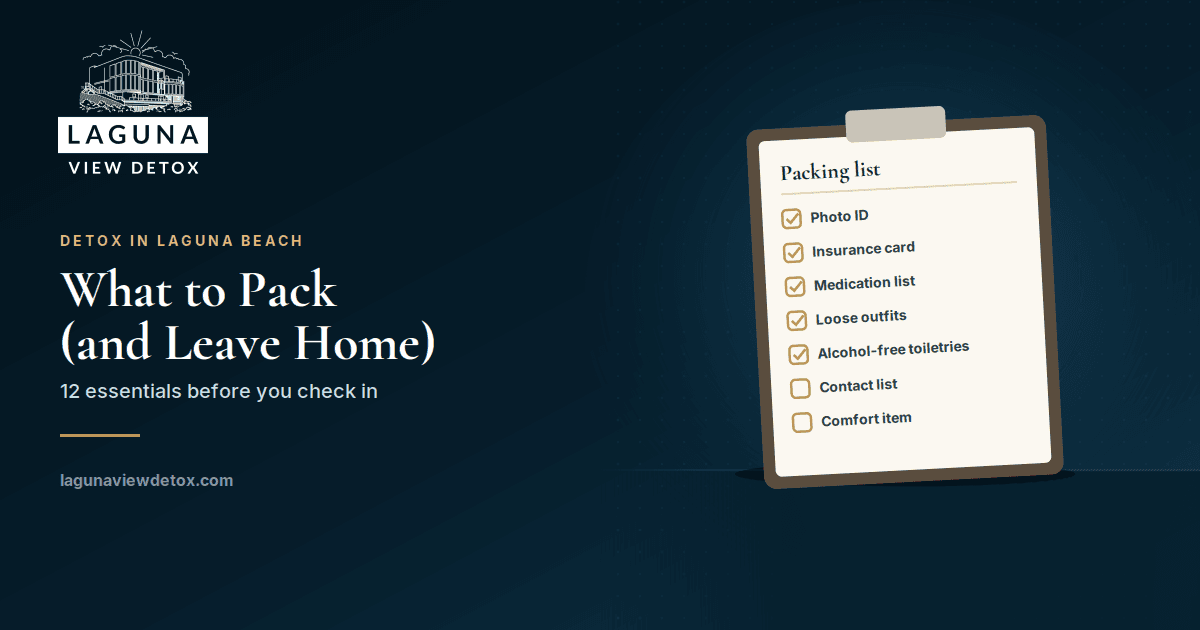
You do not need all your paperwork to call. Start with your insurance card and a first name. If you are comparing detox with insurance Laguna Beach options, you can find our medical detox details on the medical detox page. If you are packing for admission, see what to pack and leave home.

What to do if your insurance claim is denied
A denial feels final, but it is the start of a process. You have the right to appeal, and the denial letter must explain the reason and how to challenge it. Act quickly, because appeal deadlines are short.
Get the denial in writing and read the stated reason.
Ask the treating physician for a letter explaining why detox is medically necessary.
Request a peer-to-peer review, where our doctor speaks with the insurer's reviewer.
File a formal appeal, and keep copies of everything.
If the appeal fails, ask about an external review by an independent party.
For help finding treatment while you sort this out, SAMHSA's National Helpline is a free resource listed on its site.[1] NIDA also lists 1-800-662-HELP (4357).[4]

Frequently Asked Questions
Q: Does insurance cover detox in Laguna Beach, California?
A: Often, yes. Many private plans cover medical detox when it is medically necessary, but the details vary by plan. A verification of benefits will tell you what yours covers for detox with insurance Laguna Beach programs provide.
Q: How do I find out if Laguna View Detox is in-network with my insurance plan?
A: Call our admissions team with your member ID, and we will check. You can also call the number on your card and ask whether we are in-network.
Q: What is a verification of benefits, and how long does it take?
A: It is a check with your insurer of what your plan pays for treatment. It is often completed the same day, though some insurers take longer.
Q: How many days of detox will my insurance typically cover?
A: There is no single number. Insurers usually approve a few days, then review your progress and approve more if care is still needed. Your clinical needs and plan terms decide it.
Q: What can I do if my insurance denies coverage for detox or says it isn't medically necessary?
A: Appeal. Ask for the reason in writing, get a physician letter, request a peer-to-peer review, and file a formal appeal. An external review is available if the appeal is denied.
Conclusion
Planning detox with insurance Laguna Beach families can rely on comes down to eight questions: coverage, network status, verification of benefits, your costs, length of stay, pre-authorization, level of care, and what comes after. Write the answers down. If a denial comes, you still have options.
Call Laguna View Detox at lagunaviewdetox.com. Have your insurance card in hand, and we will start the verification with you.
References
Substance Abuse and Mental Health Services Administration. (n.d.). SAMHSA home page: Helplines, treatment locators, and insurance resources. https://www.samhsa.gov
American Society of Addiction Medicine. (n.d.). ASAM home page and The ASAM Criteria, 4th Edition. https://www.asam.org
National Institute on Alcohol Abuse and Alcoholism. (n.d.). NIAAA home page and Alcohol Treatment Navigator. https://www.niaaa.nih.gov
National Institute on Drug Abuse. (n.d.). NIDA home page. https://nida.nih.gov